
May 12, 2026
True Peak and LUFS Explained Before Release
True peak and LUFS are useful mastering numbers, but they do not tell the whole story. This guide explains how they help with loudness, conversion safety and release preparation.
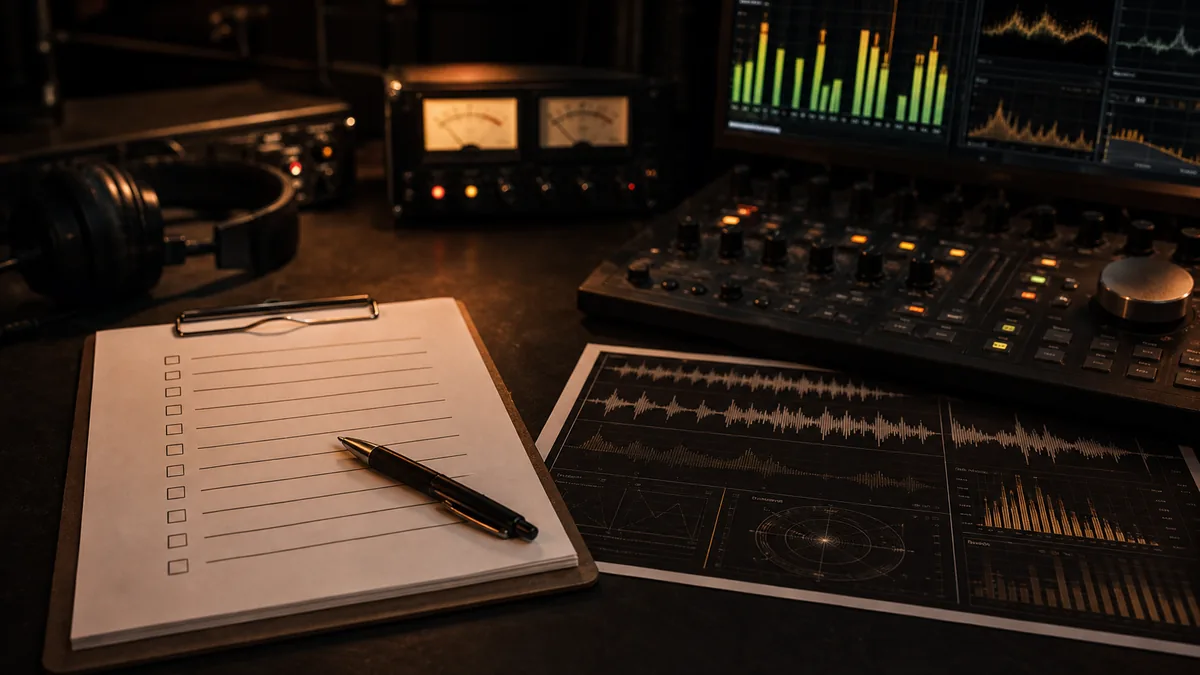
What these numbers mean and why they matter before uploading your track.
True peak and LUFS are two of the most misunderstood numbers in music release preparation.
Artists see them in mastering plugins, loudness meters, distributor advice, YouTube videos and random forum arguments that somehow become spiritual wars by page three.
One person says your track must hit a specific LUFS number. Another says LUFS does not matter anymore. Someone else says true peak is the only thing that matters. Then a guy with a cracked limiter preset says “just make it loud bro”.
Helpful. Very holy. Very professional.
The truth is more practical.
LUFS and true peak are useful, but they are not the whole story. They are guardrails. They help you understand loudness, playback safety and conversion risk before release. But they do not tell you whether the song feels good, whether the low end translates, whether the vocal sits properly, or whether the master actually works in real life.
A release-ready master is not just a file with impressive numbers.
It is a track that survives listening.
What is LUFS?
LUFS stands for Loudness Units relative to Full Scale.
In plain English, LUFS is a way to measure perceived loudness. Not just the highest peak. Not just how tall the waveform looks. Perceived loudness.
That matters because two masters can peak at almost the same level and still feel very different in loudness. One may feel open and balanced. Another may feel crushed, dense and tiring. Peak level alone does not explain that.
LUFS gives a better reference for how loud a track feels over time.
This can help during mastering because it shows whether a track is wildly quiet, extremely pushed, or roughly sitting in a sensible release range for its style.
But LUFS is not a creative commandment carved into stone.
It is a meter reading.
Useful, yes. Sacred, no.
What LUFS helps with
LUFS helps you compare loudness in a more meaningful way.
It can show whether the master is:
- too quiet compared with its release context
- aggressively crushed for no good reason
- inconsistent between sections
- much louder or softer than similar tracks
- likely to be turned down during playback normalization
- losing punch because loudness was pushed too hard
This is useful because loudness affects perception.
If a master is too quiet, it may feel weak. If it is pushed too hard, it may feel loud at first but smaller after repeated listening. That is the trap.
A lot of bad masters are not bad because they are quiet.
They are bad because they chased loudness until the song stopped breathing.
What LUFS does not tell you
LUFS does not tell you whether the track is good.
It does not tell you if the vocal is too sharp.
It does not tell you if the bass is muddy.
It does not tell you if the chorus lifts emotionally.
It does not tell you if the snare is annoying.
It does not tell you if the master translates on phones, cars or headphones.
A track can have a “nice” LUFS reading and still sound terrible.
That is why using LUFS as the only target is dangerous. It makes people master with their eyes instead of their ears.
Numbers can guide the process, but they cannot replace taste.
What is true peak?
True peak estimates the highest reconstructed peak of the audio signal after digital-to-analog conversion or codec processing.
That sounds technical because it is technical.
Here is the simpler version:
A normal peak meter shows sample peaks inside the digital file. But when that audio is converted, streamed, encoded or played back, the signal can create peaks between those digital samples. These are often called inter-sample peaks.
That means a file can look safe on a basic meter, but still distort after conversion or playback.
True peak metering helps estimate that risk.
This matters before release because your WAV is not always what the listener hears directly. Platforms may encode it, convert it or play it through systems that expose peak problems.
What true peak helps with
True peak control reduces the chance of distortion after streaming, encoding or playback conversion.
It is especially useful when a master is loud, bright, dense or heavily limited.
True peak checking can help catch:
- conversion distortion
- inter-sample peak risk
- harsh choruses
- brittle high end after upload
- crackly transients
- limiter stress
- masters pushed too close to the edge
This does not mean every master needs to be timid.
It means the master should have enough safety to survive real playback.
There is a difference between a confident master and a master standing on a cliff edge in fake sunglasses.
Why true peak matters after upload
A master can sound clean as a WAV and slightly distorted after upload.
That can happen because the platform encodes the file, changes playback format or reveals peak issues that were not obvious in the studio.
This is especially risky when the master has been pushed hard for loudness.
The track may feel exciting in the DAW, then become harsher after conversion. Cymbals get splashy. Vocals get sharp. Kicks and snares feel slightly cracked. The chorus feels less open.
Then the artist thinks the platform ruined the track.
Sometimes the platform simply exposed a master that was already too close to breaking.
LUFS vs true peak
LUFS and true peak measure different things.
LUFS is about perceived loudness.
True peak is about peak safety and conversion risk.
They work together, but they do not replace each other.
A master can have a sensible LUFS reading and still have true peak problems.
A master can have safe true peak values and still feel too quiet, too flat or emotionally weak.
That is why both numbers matter, but neither number tells the whole musical story.
The practical question is not:
“What number did the meter show?”
The better question is:
“Does this master sound strong, clean and stable after real-world playback?”
That is the grown-up version. Less sexy, more useful.
Should you master to a specific LUFS target?
This is where people get obsessed.
The internet loves simple targets because simple targets feel safe. But music is not one spreadsheet.
Different genres, arrangements and release contexts need different loudness decisions. A dense electronic track, an acoustic ballad, a dark indie rock song and an AI-generated pop track do not all need the same loudness treatment.
A master should not be forced into one number just because a blog post said so.
Use LUFS as a reference, not a prison.
If the song needs more openness, do not crush it just to hit a number. If the style needs impact and density, do not leave it weak because you are scared of a meter.
The right loudness is the one that serves the track and survives release.
Why louder is not always better
Louder feels better in quick comparisons.
That is the problem.
If you play two versions and one is louder, your ear often thinks it is better. More exciting. More finished. More expensive.
But after level matching, the truth often changes. The louder version may have less punch, more distortion, harsher vocals and weaker emotion. It only won because it shouted first.
That is why mastering should not be judged only by loudness.
A good master should feel strong without destroying the song. It should be controlled, not strangled.
Loudness is useful.
Loudness obsession is how mixes go into the oven and come out as toast with a limiter on it.
Why AI-generated music needs extra care
AI-generated and AI-assisted tracks often arrive with loudness and peak problems already baked in.
The audio may be:
- over-compressed
- fake-wide
- harsh in the high end
- unstable in the low end
- full of smeared transients
- already limited before mastering
- distorted in ways that are hard to undo
- inconsistent between sections
That makes LUFS and true peak checking even more important.
Not because AI music is automatically bad, but because AI-generated audio often has hidden technical baggage. A track may sound “finished” at first, but under proper listening it can reveal harshness, weak dynamics, strange stereo behavior or codec risk.
In those cases, mastering is not just about loudness.
It is about damage control, musical balance and release safety.
The practical view
Use LUFS and true peak as guardrails.
They can help you avoid obvious mistakes. They can warn you when a master is too quiet, too crushed, too risky or too close to distortion after conversion.
But they should never replace listening.
The real test is still:
- Does the vocal feel right?
- Does the low end translate?
- Does the chorus lift?
- Does the track survive headphones?
- Does it work on small speakers?
- Does it stay clean after codec conversion?
- Does it feel musical after repeated listening?
Those questions matter more than a screenshot of a meter.
Meters do not listen to music.
People do.
What a release-ready master should do
A release-ready master should be technically controlled and musically convincing.
It should have:
- sensible loudness for the style
- controlled true peak risk
- balanced tone
- stable low end
- clear vocal presence
- enough punch
- enough space
- clean playback after conversion
- good translation across normal systems
It should not feel like the track was mastered only to impress a plugin meter.
The best mastering decisions usually feel boring on paper and obvious in the speakers.
That is the craft.
Final advice
True peak and LUFS matter, but they are not magic numbers.
LUFS helps you understand perceived loudness. True peak helps you reduce distortion risk after conversion and playback. Both are useful before release.
But the final decision still belongs to the ear.
A master should not only look correct. It should feel strong, balanced and musical across normal listening systems.
At Unsaid Records, mastering and Release Pre-Flight QC use numbers as guardrails, not as a substitute for judgement. The goal is not to chase a meter. The goal is to prepare a track that sounds finished, survives release and still feels like music when it reaches the listener.
No fake loudness religion. No mystery numbers. Just practical audio finishing before the file leaves your hands.